


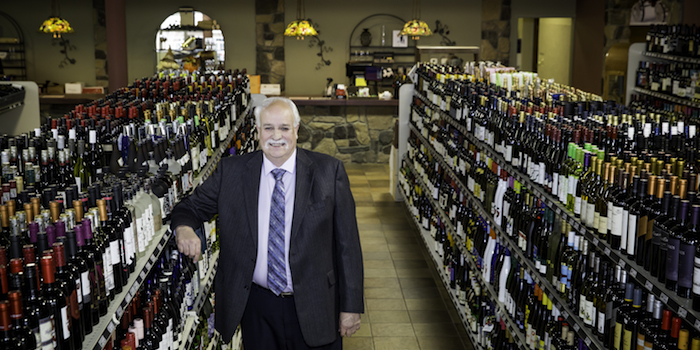
Beverage Dynamics began presenting individual “Retailer of the Year” awards in 1996. Over the years, we’ve profiled dozens of industry leaders; these are the best of the best. This year, we’ve expanded the tradition by awarding our top honor to two retailers, recognizing a regional chain and a two-store operation looking to expand. Congratulations to Cork Liquors and Half Time Beverage, the 2016 Retailers of the Year!
Cork Liquors Fast Facts
- Owner: Warren Scheidt
- Founded: 1982
- Locations: 11 (Columbus, Shelbyville and Greensburg, IN)
- Size: 2,800 to 13,000 square feet
- Offerings: Beer, wine, spirits and cigars
- Specialties: Walk-in humidor
Patience Pays Off
The first 2016 Retailer of the Year is a family-owned chain of about a dozen stores located in and around Columbus, Indiana. Cork Liquors is owned by Warren Scheidt, an active member of the beverage alcohol industry who’s the current president of the American Beverage Licensees (ABL), a trade association for on- and off-premise retailers.
The first Cork location opened in Columbus in 1982, after Warren’s family obtained a permit for a new store in town in partnership with his parents Virgil and Bettie, and his brother Don.
“We knew absolutely nothing about the business,” Scheidt says. “My father always wanted a package liquor store, so when it became available we got together and started the business in a 4,800 square-foot store, which was a big store at the time.” Since then, the original location has undergone three additions and now stands at 13,000 square feet – the largest in the chain.
At the time the Scheidts obtained their permit, local boards collected and approved applications. Permits were issued on a quota system, with one store allowed in a town or city per 5,000 people. Since then, state law has changed so that a commission in Indianapolis auctions permits off for the entire state.
“Thirty years ago they thought local people were better to choose who got the permits because they knew their fellow citizens,” Scheidt says. “When we applied, we were one of 13 groups. We ended up getting the permit because we were the only ones who filled out all the information correctly.”
At first, Bettie Scheidt ran the store during the day since her husband and sons worked full-time elsewhere. Warren, Don and Virgil divided up the six days of the week the store was opened (Indiana still doesn’t allow sales on Sunday) and worked the evening shifts.
“We each worked two nights a week for many years, until the time when we acquired more stores,” Scheidt says. “We really made it a family business, and we put every dime we made back into the company.”
Unintended Growth
Over the years, Cork has grown through acquisition, as stores in Columbus or surrounding towns became available. More than a few times, the sellers came to Scheidt and asked him to buy them out. Other times, very little persuasion was required.
“There was a fellow in town who owned two stores, and I saw a sign outside his store one day saying he was selling Coke machines,” Scheidt says. “I stopped to chat with him and told him if he ever wanted to sell, I’m always interested in expanding. He told me, ‘I’m ready to sell right now.’” Within a few days, Cork Liquors had two new locations.
Scheidt owns all seven permits for Columbus, which has a population of about 40,000. It took nearly 22 years to collect them all, which he says required patience. In the case of Shelbyville, where all four permitted stores in town are Cork locations, luck was on his side.
“I was out of town and got a call from a retailer in Shelbyville asking me if I’d like to buy his two stores because he wanted to sell,” Scheidt says. “Within a few days we worked out a deal. Less than three months, another guy who owned the other two permits in town asked me to buy his business too. I’d never spoken to him before, so it wasn’t any aggressive marketing on my part. I was just answering the phone.”
Across all 12 locations (there’s one Cork Liquors in Greensburg), Scheidt’s retailing philosophy ties the chain together.
“I’ve always believed that no matter how much you dislike the competition – Kroger, Walmart, all the big guys – there are certain things they do right,” he says. “If you look at beverage retailing, that includes wide aisles, well-lit displays and clean stores.”
Cork’s marketing philosophy is to offer competitive pricing and a large selection in every market. While some smaller stores don’t carry every niche product (stores range from 2,800 to 13,000 square feet), each town offers a full range of products across its stores.
“Every area is unique,” Scheidt says. “Columbus is a small town, but every neighborhood is different. When we set up a store in a new market, we have to stock the basics like Bud Light and Jim Beam, but we also begin to sort out what sells and what doesn’t on a store level. There’s no specific product mix – we start tweaking the stocking and it can take up to a year before we get to an ideal mix for the customer base.”
Above all, Cork’s number one strength is location. “My family was in the real estate business, so one of our keys to success is placing stores where they should be,” Scheidt says. “You can’t always compete with CVS for the best locations, but you can be somewhere with good access and an attractive building. For example, Shelbyville is divided into quarters by two highways that run north to south and east to west, so we’re trying to get a store into each quarter of town, near the highway exits.”
“It’s taken five years to get the location we wanted for a store we’re building now (to open by July),” he adds. “It takes patience, but the old saying is correct: it’s all about location, location, location.”
Working as a Family
Cork Liquors is among the rare family businesses to last through three generations – Warren’s son Travis, daughter Allison and son-in-law all work at the company full-time.
“My favorite part of being a retailer is having my family heavily involved in the business,” Scheidt says. “Allison is only a few feet away from me and runs our business office, and her husband is the liquor buyer at our main store. Travis oversees all of our marketing and pricing and specializes in craft beer. Having my family here is a big treat for me.”
Warren’s brother Don handles the company’s real estate acquisitions, leases and property purchases, given his background as a realtor. Allison joined the business after she graduated from Purdue in 2008, and Travis came on board in 2006 following his graduation from Ball State. While he was in school, Travis worked at a number of Indiana beer wholesalers, giving him a unique perspective on the industry. One day, Scheidt hopes his children will pass the business on to the fourth generation.
“I’m going to live forever, even though I haven’t figured out the details yet,” he jokes. “But it’s very important for me to keep the business family-owned. I would still only have seven stores if it wasn’t for them.”
When the opportunity to purchase four locations in Shelbyville came along, Scheidt was hesitant to expand. At that stage of his life, he “had a good thing going” in his hometown and didn’t have the need or desire to expand into a new market. But his children were young and aggressive and willing to commit to joining the business when they finished college.
“That made all the difference in the world,” he says. “Now I’m committed to serving small, outlying communities where we can make a significant difference in the types of stores we build and the products we sell. Every town we’ve entered, we’ve tried to make things better than they were before we arrived. We want to be an asset in the community, and that’s something you can do in a small town.”
Not Always Smooth Sailing
Like any business, Cork Liquors has faced its share of challenges over the years.
“We face the same hardships as any small business – mostly difficulties in finding a consistent labor force and competing against larger stores,” Scheidt says.
The towns where Cork operates are home to a number of large manufacturers. Cummins, a diesel engine manufacturer, is located in Columbus, and Greensburg is home to a Honda plant.
“Our unemployment rate is very low, so people are at a premium – especially good ones,” he adds. “But from speaking to retailers around the country, I know a competitive labor market isn’t unique to southern Indiana.”
In addition to increased labor costs, Cork competes against stores that sell a wide variety of products that package stores aren’t allowed to carry. To make things worse, many of these big box stores sell alcohol as a loss leader, below cost.
“They’re not doing anything illegal – if these stores want to lose money on certain products, that’s their prerogative,” Scheidt says. “But I’d rather see it not take place, especially when all I can sell is alcohol products.” Other than cold beer, big box stores like Walmart and Kroger can sell any items found in Cork locations.
“People need food, fuel, clothing and medicine – all things these stores can sell legally that I can’t,” he adds. “When a competitor can sell the staples of life and then turn around and offer the only products we carry to consumers at below cost, I don’t like it very much. If those stores can afford to lose money, they should lower their prices on things that people need.”
Industry Involvement
In part because of Indiana’s complex regulations governing the beverage alcohol industry, Scheidt has long been involved in networking with and fighting alongside his fellow retailers.
“I joined our state association in 1984 because I was raised in a political family,” he says. “It came naturally to be involved with the inner workings of the industry I was involved in. From early on it was obvious to me that, in an industry where everything you do hinges on what the legislature says you can do, you should be involved in the process or you may not have a business to be involved in.”
Scheidt was the longest-serving president of the Indiana Association of Beverage Retailers, held nearly every elected office and served on every committee. The IABR’s membership is very strong on a per-capita basis, with nearly 50% of state retailers participating in the association.
“I worked my way up and paid my dues, and then the reason I joined the ABL was because I’d already done everything on the state level,” he says, adding jokingly, “I think they sent me to Washington to serve on the national committee to get rid of me because there was nothing left for me to do.”
Nationally, the ABL is focused on sharing information among its state association members, as well as lobbying members of Congress to serve its membership’s interests.
“State regulations affect retailers during their day-to-day business and you really notice changes in the law very quickly,” he says. “On a national level, the changes are more subtle and often we need to team up with other industry associations to accomplish the things we believe in.”
The ABL has recently worked on issues as varied as doing away with the “death tax,” transportation bills, interlock regulations and repeat-offender laws.
Scheidt was elected president of the ABL in June and is currently serving a two-year term. He’s previously been the association’s vice president, treasurer and chairman of the communications and finance committees.
“I’m running out of positions again, like at the state level” he says. “I’m not sure what I’ll do next, but I’m always looking for new opportunities and keeping my ears open.”
Jeremy Nedelka is editor of Beverage Dynamics Magazine. Reach him at JNedelka@epgacceleration.com

[…] Click here to read the full three page spread […]
[…] Retailer of the Year: Cork Liquors […]